


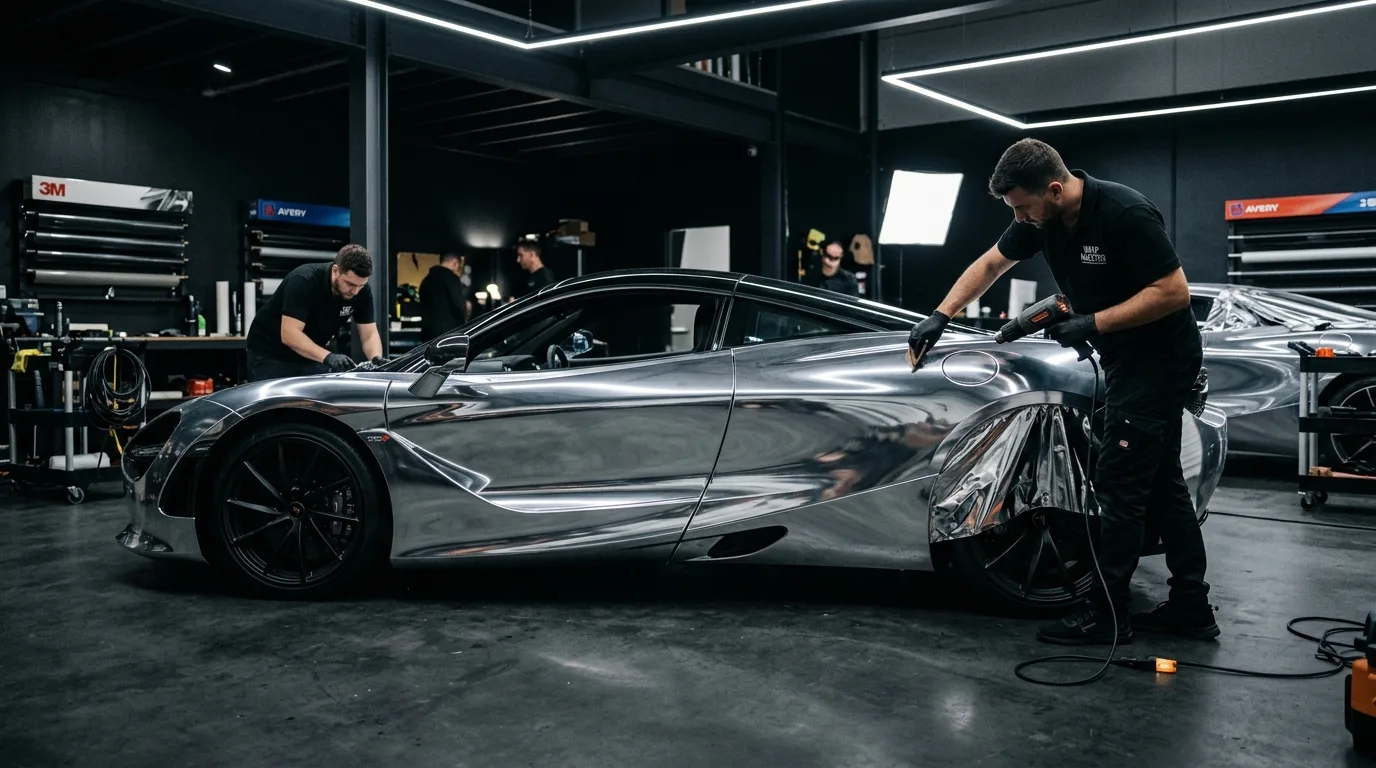

Introduction to Chrome Car Wraps
As a seasoned vinyl wrapping specialist with over 15 years of experience, I can attest that chrome car wraps are in a league of their own. These wraps are not just a color change, but a statement that can turn heads like no other. However, let’s be honest, they are arguably the most challenging material to work with. But with the right knowledge, tools, and patience, you can achieve that dazzling, mirror-like finish that will make your vehicle stand out from the crowd.
Table Of Content
- Introduction to Chrome Car Wraps
- Preparation: The Foundation of a Flawless Chrome Wrap
- Deep Cleaning and Surface Perfection
- Essential Tools for Chrome Wrapping
- Specialized Tools for a Flawless Finish
- Installation Techniques for Chrome Wraps
- Conforming to Complex Curves and Edges
- Maintenance and Removal of Chrome Wraps
- Wash Intervals and Waxing Rules
So, what makes chrome vinyl so unique and tricky to work with? For starters, chrome vinyl is a multi-layered film with a highly reflective metallic layer sandwiched between a protective clear coat and the adhesive-backed cast vinyl. This construction gives it unique properties, such as thickness and rigidity, scratch sensitivity, zero forgiveness, and limited stretch. These properties make it essential to approach chrome wrap installation with caution and precision.
Popular chrome brands include Avery Supreme Wrapping Film Chrome, Oracal 970RA Chrome, Hexis Skintac HX30000 Chrome, and KPMF K75400 Chrome. Each has slightly different characteristics, but the installation principles remain similar. For instance, Avery Supreme Wrapping Film Chrome is known for its high-gloss finish and ease of installation, while Oracal 970RA Chrome is renowned for its durability and resistance to scratches.
Preparation: The Foundation of a Flawless Chrome Wrap
Deep Cleaning and Surface Perfection
If preparation is 80% of any wrap job, it’s 95% for chrome. You simply cannot cut corners here. A thorough two-bucket wash with a pH-neutral automotive soap is essential to remove dirt, grime, and other contaminants that can interfere with the wrap’s adhesion. Follow up with a clay bar treatment to remove embedded contaminants, and finally, wipe down every inch of the surface with a 50/50 Isopropyl Alcohol (IPA) and water solution. Use new, lint-free microfiber cloths to prevent scratches and marks.
Surface perfection is critical for chrome wraps, as any imperfections will be magnified by the reflective surface. Any bodywork should be done before wrapping, and ensure the paint is smooth and blemish-free. I recall a project where the client’s vehicle had a minor scratch on the hood. We had to respray the entire hood to achieve a flawless finish. It was a costly and time-consuming process, but the end result was well worth it.
Disassembly is also key to a truly seamless chrome finish. You’ll need to remove door handles, mirrors, emblems, lights, and trim pieces to wrap deep into recesses and achieve true edge-to-edge coverage, minimizing potential lifting. This may seem like a tedious process, but trust me, it’s essential for a professional-looking finish.
Essential Tools for Chrome Wrapping
Specialized Tools for a Flawless Finish
Your toolkit needs to be top-notch and specialized for chrome wrapping. A good quality heat gun, such as the Steinel Heat Gun, is essential for conforming the vinyl to complex curves and edges. A knifeless tape is also a must-have for trimming excess vinyl without scratching the surface. Other essential tools include a 3M rivet brush for cleaning and preparing the surface, and a microfiber cloth for wiping down the surface and removing excess moisture.
A laser alignment tool can also be useful for ensuring accurate placement and alignment of the vinyl. This is particularly important for chrome wraps, as any misalignment can be noticeable. I’ve seen many installers use a chalk line to mark the center point of the vehicle, ensuring a symmetrical finish.
In addition to these tools, it’s also important to have a clean and well-lit workspace. A dirty or cluttered workspace can lead to contamination and mistakes, which can be costly and time-consuming to rectify. A well-lit workspace, on the other hand, allows you to see the surface clearly and detect any imperfections or air bubbles.
Installation Techniques for Chrome Wraps
Conforming to Complex Curves and Edges
Installing a chrome wrap requires patience, skill, and attention to detail. The first step is to apply the vinyl to the center point of the vehicle, using a hinge method to ensure accurate placement and alignment. From there, you can work your way outwards, using a combination of heat and pressure to conform the vinyl to the surface.
Conforming to complex curves and edges can be challenging, but there are a few techniques you can use to achieve a flawless finish. One technique is to use a post-heating method, where you apply heat to the vinyl after it’s been applied to the surface. This helps to relax the vinyl and conform it to the surface. Another technique is to use a stretching method, where you stretch the vinyl over the surface, using a combination of heat and pressure to conform it to the shape.
I recall a project where we had to wrap a chrome vinyl around a complex curve on a sports car. We used a combination of heat and pressure to conform the vinyl to the surface, and then applied a post-heating method to relax the vinyl and achieve a flawless finish. The end result was stunning, with a mirror-like finish that reflected the light perfectly.
Maintenance and Removal of Chrome Wraps
Wash Intervals and Waxing Rules
Maintenance is critical to extending the life of your chrome wrap. Regular washing with a mild soap and water is essential to prevent dirt and grime from building up and damaging the vinyl. Avoid using harsh chemicals or abrasive materials, as these can damage the vinyl and cause it to deteriorate prematurely.
Waxing is also important to protect the vinyl and maintain its appearance. A good quality wax, such as Carnauba wax, can help to protect the vinyl from the elements and prevent it from fading or discoloring. However, be careful not to apply too much wax, as this can leave a residue on the surface and attract dirt and dust.
When it comes to removing a chrome wrap, it’s essential to use the right techniques and tools to avoid damaging the surface. A heat gun can be used to soften the adhesive and make it easier to remove the vinyl. A removal solution, such as Goo Gone, can also be used to help dissolve the adhesive and make it easier to remove the vinyl.