


Mastering Heat Application: Advanced Heat Gun Techniques for Complex Curves and Deep Recesses

Mastering Heat Application: Advanced Heat Gun Techniques for complex curves and Deep Recesses
Welcome back to Car Wrap Info! As your seasoned wrap expert with over 15 years under the belt, I’ve seen countless wraps – the good, the bad, and the downright ugly. What often separates a stunning, long-lasting wrap from a bubbling, lifting mess? More often than not, it’s the mastery of heat application. For DIY wrappers and even aspiring pros, understanding how to properly use a heat gun on complex curves and deep recesses is a game-changer. It’s not just about getting the vinyl to stick; it’s about making it conform perfectly, ensuring durability, and achieving that flawless, paint-like finish.
Table Of Content
- Mastering Heat Application: Advanced Heat Gun Techniques for complex curves and Deep Recesses
- The Science of Heat and Vinyl: Why It Matters
- Your Essential Heat Application Toolkit
- Understanding Temperature Zones: The Sweet Spot
- Advanced Techniques for Complex Curves and Deep Recesses
- 1. The “Bridge and Arch” for Compound Curves
- 2. “Oil Canning” & Controlled Shrinkage for Large Panels
- 3. The “Finger Technique” for Deep Recesses & Door Handles
- 4. Post-Heating: The Non-Negotiable Step
- Common Mistakes to Avoid
- Pro Tip: Practice Makes Perfect
Today, we’re diving deep into advanced heat gun techniques. Forget just blasting heat; we’re talking precision, control, and a bit of finesse that will elevate your wrapping game.
The Science of Heat and Vinyl: Why It Matters
Before we pick up the heat gun, let’s quickly recap what heat does to your vinyl. When you apply heat, you’re making the vinyl pliable, allowing it to stretch and conform to the vehicle’s contours. Crucially, heat also activates the adhesive, ensuring a strong, lasting bond. However, vinyl films, especially premium cast vinyl (the high-quality, heat-activated film like 3M 2080 or Avery Supreme Wrapping Film that conforms beautifully to complex curves without shrinking back), have a “memory.” This means they’ll try to return to their original, flat state if not properly handled and post-heated. Calendered vinyl, on the other hand, is a more affordable, stiffer film better suited for flat surfaces, and it has a much stronger memory effect, making it unsuitable for complex curves.
Your Essential Heat Application Toolkit
You can’t master heat without the right tools:
- Variable Temperature Heat Gun: This is non-negotiable. You need control over the temperature. I recommend a quality model like the Steinel HG 2320 E or a Milwaukee M18 FUEL heat gun for cordless flexibility. Look for a wattage of at least 1500W.
- Infrared (IR) Thermometer: Your best friend for consistency. Brands like Klein Tools or FLIR offer reliable options. It lets you accurately measure the film’s surface temperature, preventing overheating and underheating.
- Heat-Resistant Gloves: Protect your hands while working hot vinyl into recesses.
- Lint-Free Cloths: Keep the surface clean, especially after heating.
Understanding Temperature Zones: The Sweet Spot
There isn’t one magic temperature for all wraps. Generally:
- Stretching/Conforming: Aim for 180-200°F (82-93°C). This makes the film pliable enough to stretch without damaging its integrity or the adhesive.
- Post-Heating: This is critical! Temperatures should be higher, typically 200-220°F (93-104°C), to completely remove the vinyl’s memory and ensure the adhesive is fully cured, preventing lift and shrinkage over time.
Too cold, and the vinyl won’t stretch or adhere properly. Too hot, and you risk overstretching (leading to “ghosting” or discolored areas), melting the film, or damaging the adhesive. Always keep the heat gun moving, typically 6-12 inches away from the surface, to distribute heat evenly.
Advanced Techniques for Complex Curves and Deep Recesses
1. The “Bridge and Arch” for Compound Curves
For areas like fenders, bumpers, or mirror caps with curves in multiple directions (compound curves), avoid trying to force the vinyl flat. Instead:
- Create a Bridge: Position the vinyl over the curve, letting it naturally bridge the gap. Apply light tension outwards.
- Introduce Heat: With your heat gun, gently heat the center of the bridged area, keeping the gun moving.
- Squeegee into the Arch: As the vinyl becomes pliable, slowly work your way from the center outwards with your squeegee, pushing the film into the arch. The heat allows the film to “shrink” itself into the curve without excessive stretching.
- Managing Tension: This technique is about managing tension. You want enough tension to guide the film, but not so much that you overstretch it. Think of it as letting the film relax into the shape.
2. “Oil Canning” & Controlled Shrinkage for Large Panels
On large, complex panels (like a front fender on a 2024 Tesla Model Y), you might see areas where the vinyl looks like stretched metal (“oil canning”). This means uneven tension. To fix this:
- Identify Tension Pockets: Look for areas where the film isn’t lying perfectly flat.
- Heat and Shrink: Apply heat to the affected area while gently pulling the film slightly away from the surface. The heat will allow the stretched vinyl to shrink back to a more relaxed state. Then, re-squeegee it down. This is crucial for preventing wrinkles and lifting later.
3. The “Finger Technique” for Deep Recesses & Door Handles
Deep recesses like door cups, bumper vents, or around emblems are challenging. The “finger technique” is invaluable:
- Isolate the Area: Work the vinyl up to the edge of the recess.
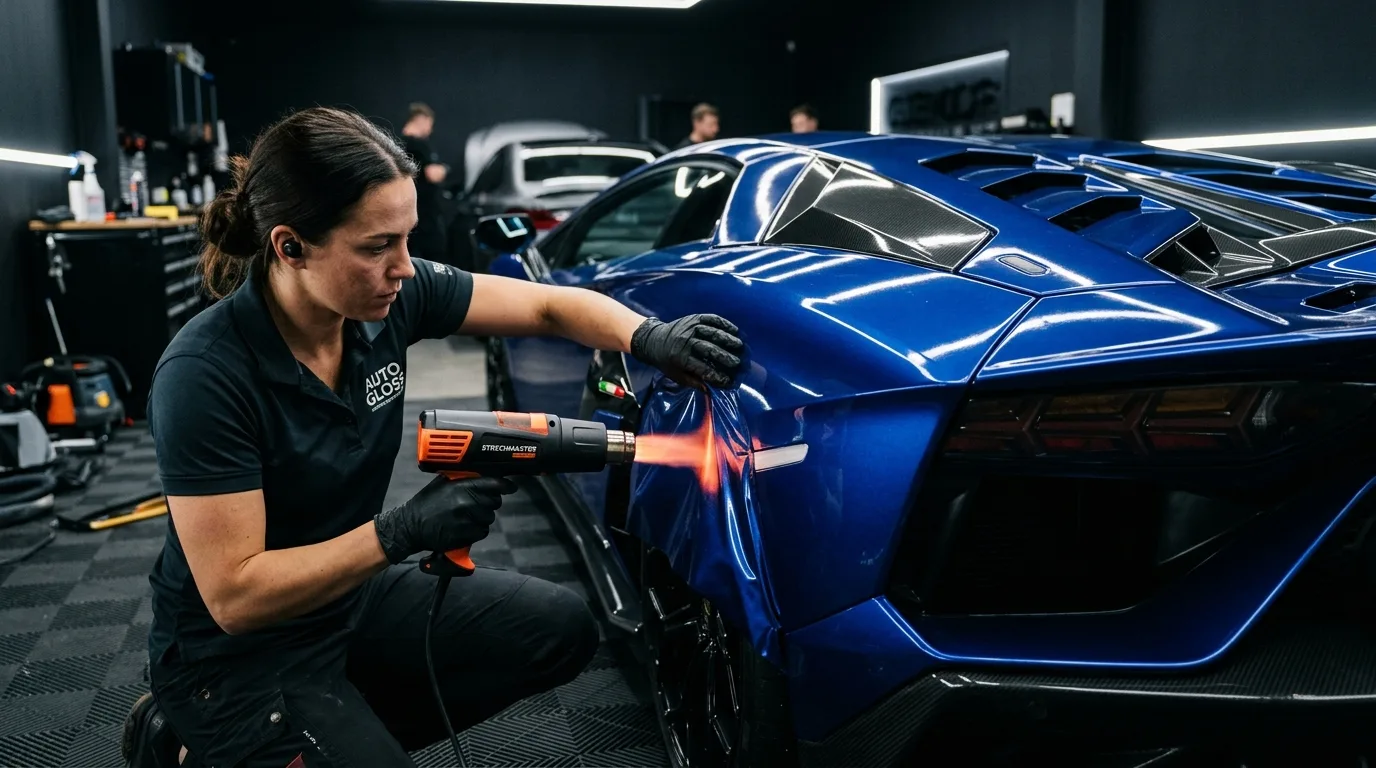
- Heat & Push: Apply controlled heat to a small section of vinyl directly over the recess. As it becomes soft, use your (gloved!) finger or a soft-tipped squeegee to gently push the vinyl into the recess. Work from the center outwards, carefully pushing out any air.
- Relief Cuts (Last Resort): For extremely deep or sharp recesses, small, strategic relief cuts might be necessary to avoid excessive stretching. Make them as small as possible and aim to overlap the film slightly to hide the cut.
4. Post-Heating: The Non-Negotiable Step
I cannot stress this enough: Post-heating is paramount. For a full wrap on a Ford F-150 crew cab, you’ll spend hours applying film, but if you skip post-heating, it’s all for naught. After the entire section is laid down and trimmed:
- Even Application: Go over every square inch of the wrapped surface with your heat gun, aiming for 200-220°F (93-104°C). Use your IR thermometer frequently to ensure you hit these temps.
- Focus on Edges & Recesses: Pay extra attention to all edges, corners, and areas where the film was stretched or conformed into recesses. These are the first places to lift if not properly post-heated.
- Dwell Time: Don’t just flash the heat. Allow the heat to penetrate the film for a few seconds in each spot. This completely cures the adhesive and removes the vinyl’s memory, ensuring it stays put for its intended 5-7+ year lifespan.
Common Mistakes to Avoid
- Overstretching: Leads to “ghosting” (lightening of the film’s color), adhesive failure, and premature cracking. Always heat and stretch just enough to conform.
- Underheating: Results in poor adhesion, lifting edges, and the vinyl wanting to pull back (memory effect).
- Stationary Heat Gun: Never hold the heat gun in one spot for too long. You’ll burn the vinyl or even damage the paint underneath. Keep it moving!
- Ignoring the IR Thermometer: Guessing temperatures is a recipe for disaster. Use your thermometer!
Pro Tip: Practice Makes Perfect
Don’t jump straight to your dream car! Grab some scrap vinyl (even some old 3M 1080 or Oracal 970RA cut-offs) and practice on spare body panels, a motorcycle helmet, or even complex household objects. The more you practice controlled heating and stretching, the more confident and skilled you’ll become.
Mastering heat application isn’t just a technique; it’s an art. With patience, the right tools, and these advanced strategies, you’ll be achieving professional-level results and making your wraps last longer and look sharper than ever. Keep wrapping, and if you have questions, Car Wrap Info is always here to help!