


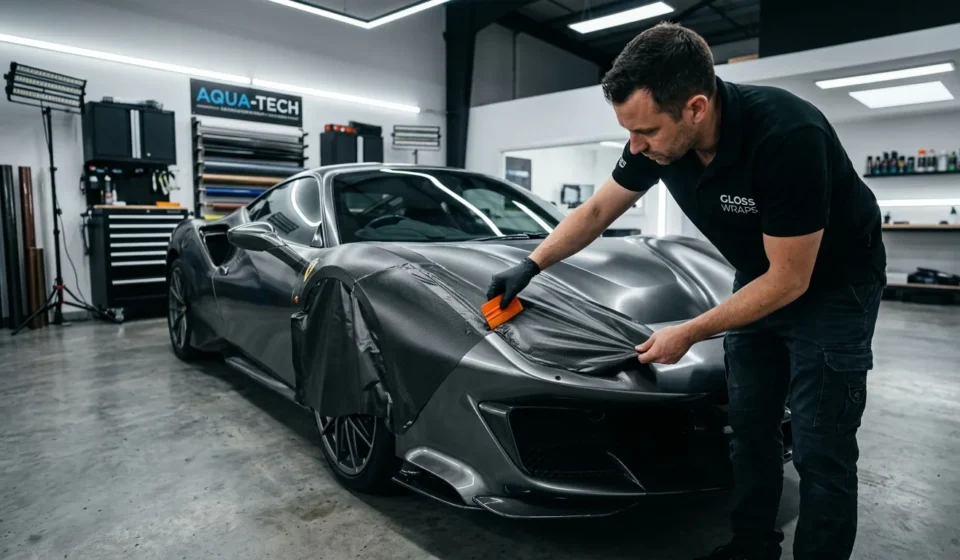

Ever gazed at a jaw-dropping vehicle wrap and wondered how they came up with that design? It’s more than just slapping some graphics on a car; it’s an art form, a science, and frankly, a bit of magic when done right. As someone who’s spent over 15 years in the trenches, wrapping everything from compact cars to massive fleet trucks, I can tell you that a stunning wrap starts long before the vinyl even touches the paint. It begins with a killer design.
Table Of Content
- Clarifying Your Vision: What’s Your Wrap’s Story?
- Personal Style vs. Business Branding
- Considering Your Vehicle’s Identity
- Budget & Longevity: Setting Realistic Expectations
- The Art & Science of Wrap Design Principles
- Color Theory: More Than Just Pretty Hues
- Typography & Messaging: Make It Readable
- Scale, Flow, and Real-World Curves
- Bringing Your Design to Life: DIY vs. Pro Designer
- Communicating Your Vision to a Professional
- Software & File Types for DIYers
- The Critical Role of Pre-Press & Mockups
- Material Matters: How Film Choice Impacts Design & Durability
- Cast vs. Calendered: The Foundation
- Finishes & Special Effects: Elevating Your Look
- Practical Considerations: Printability & Longevity
- Finalizing Your Masterpiece: Pre-Installation Checks
- Digital Proofs & Test Prints: Seeing is Believing
- The Post-Design Huddle: Your Installer’s Perspective
You want your vehicle to stand out, tell a story, or powerfully represent your brand. But how do you translate that vision into a design that not only looks fantastic but also installs flawlessly and lasts for years? That’s what we’re diving into today on Car Wrap Info. Let’s get real about vehicle wrap design.
Clarifying Your Vision: What’s Your Wrap’s Story?
Before any design software even opens, you need to understand the ‘why’ behind your wrap. Is it a personal expression, a rolling billboard for your business, or a protective layer with a splash of color? Your purpose dictates everything from design complexity to material choice and, ultimately, your budget. Don’t rush this step. It’s the foundation of your entire project.
Personal Style vs. Business Branding
If you’re wrapping your personal ride, the sky’s the limit for creativity. Maybe you want a sleek matte black color change wrap on your 2024 Tesla Model Y, or a wild custom graphic featuring your favorite anime characters. For personal wraps, aesthetics and self-expression are paramount. You can take risks, experiment with bold colors or intricate patterns. For example, imagine this situation: You’ve always dreamed of a car that looks like it rolled straight out of a sci-fi movie. This is your chance to make it a reality, perhaps with a cosmic gradient and subtle metallic flake vinyl.
However, if this is a business vehicle, your design needs to be strategic. What message do you want to convey? Who is your target audience? A wrap for a plumbing company needs to be clear, readable, and professional, not overly abstract. It needs to include your logo, contact information, and a clear call to action. Legibility at 60 mph is crucial!
Considering Your Vehicle’s Identity
Every vehicle has its own lines, curves, and unique features. A design that looks amazing on a flat canvas might fall apart when applied to the complex contours of a Porsche 911 or the rivets of a Ford F-150. A great design works with the vehicle, enhancing its natural lines rather than fighting against them. Think about where door handles, mirrors, and body gaps will interrupt your graphics. Will your critical contact info get cut off by a wheel well? These are common mistakes that are easily avoidable with careful planning.
Budget & Longevity: Setting Realistic Expectations
Design complexity directly impacts cost and longevity. More intricate designs with multiple layers, specialty films, or fine details require more material, more labor, and more experienced installers. A full color change wrap on a mid-size SUV like a 2024 Tesla Model Y typically costs between $4,200–$5,800 depending on the finish (matte, gloss, satin, chrome, textured). Custom graphics or intricate designs with print work can push this significantly higher. Are you looking for a 3-year promotional wrap or a 7-year investment? This choice will guide your material selection and, by extension, your design approach. Longer-lasting wraps often demand cast vinyl – the premium, heat-activated film that conforms to complex curves without shrinking back – which is more expensive but yields superior results and durability.
The Art & Science of Wrap Design Principles
Once you understand your purpose, it’s time to dive into the core principles that make a design truly effective. This isn’t just about making it look pretty; it’s about making it work on a three-dimensional, moving canvas.
Color Theory: More Than Just Pretty Hues
Colors evoke emotions and convey messages. Red is bold and energetic, blue is trustworthy and calm, green suggests nature or money. For a business, your brand colors are usually a given, but how do they interact with the vehicle’s original color if it’s not a full wrap? Or how do they contrast with your chosen background? Always consider how colors will look in different lighting conditions – bright sunlight vs. overcast days. A vibrant neon green might look amazing in a rendering but could be overwhelming in person if not balanced correctly. Sometimes, less is more.
Typography & Messaging: Make It Readable
This is where many DIYers and even some professionals stumble. Your text needs to be clear, concise, and large enough to be read easily at a distance. Avoid overly ornate fonts for critical information. A good rule of thumb: if you can’t read it quickly from 20 feet away, it’s too small or too complex. And don’t forget kerning (the spacing between letters) and leading (the spacing between lines) – these seemingly minor details make a huge difference in readability. What good is a beautiful design if nobody can read your phone number?
Scale, Flow, and Real-World Curves
This is perhaps the most challenging aspect of wrap design. A flat 2D graphic will stretch, distort, and warp when applied to a curved surface. Experienced designers use templates that account for these distortions, often called “map templates” or “vehicle blueprints.” You need to understand how your design elements will wrap around fenders, bumpers, and mirrors. Logos should ideally be placed on flatter panels to avoid distortion. Furthermore, the design needs to flow seamlessly from one panel to the next. Jagged lines or misaligned patterns across door gaps are tell-tale signs of an amateur job. We often use specialized software to create these templates, ensuring that when the vinyl wrap is printed and applied, the design maintains its integrity.
Bringing Your Design to Life: DIY vs. Pro Designer
So you have your vision and understand the principles. Now, who actually creates the digital files? This is a critical juncture.
Communicating Your Vision to a Professional
Hiring a professional designer (preferably one with vehicle wrap experience!) is often the best route for complex or business-critical wraps. Provide them with a detailed brief: your brand guidelines, target audience, preferred colors, examples of wraps you like (and dislike!), and high-resolution logos. The clearer you are, the less back-and-forth there will be. Don’t be afraid to ask for revisions. A good designer will welcome your input to ensure the final product is exactly what you envisioned. Honestly, a well-communicated brief saves everyone time and money.
Software & File Types for DIYers
If you’re tackling the design yourself, you’ll need professional-grade software like Adobe Illustrator or Affinity Designer. These programs handle vector graphics, which are scalable without losing resolution – essential for large-format printing. Avoid raster-based programs like Photoshop for primary design elements, as images can pixelate when enlarged. Your final files should be high-resolution vector PDFs or AI files, with all fonts outlined and colors set to CMYK (for printing) rather than RGB (for screens). Raster images (like photos) should be at least 150-300 DPI at full print size. This ensures sharp, crisp graphics when printed on films like 3M 2080/1080 series or Avery Supreme Wrapping Film.
The Critical Role of Pre-Press & Mockups
Before any ink hits the vinyl, the design needs to be prepared for print (pre-press). This involves checking file integrity, color profiles, and ensuring the design fits the vehicle template perfectly. A crucial step is creating a digital mockup – a realistic render of your design on a 3D model of your specific vehicle. This allows you to see exactly how the wrap will look from all angles, identify potential issues, and make adjustments before it’s too late. I believe this stage is where most mistakes are caught, preventing costly reprints.
Material Matters: How Film Choice Impacts Design & Durability
Your design might be brilliant, but if it’s printed on the wrong material, it’s all for naught. The vinyl choice is intertwined with design success.
Cast vs. Calendered: The Foundation
When we talk about material, the first distinction is usually between cast vinyl and calendered vinyl. Cast vinyl, like 3M’s 1080/2080 or Avery Supreme Wrapping Film, is premium, thinner (2.5-3.5 mil), more conformable, and has excellent dimensional stability, meaning it resists shrinking. This is your go-to for complex curves and long-term durability (5-7+ years). calendered vinyl, on the other hand, is thicker (3.5-5 mil), stiffer, and more prone to shrinkage over time. It’s more affordable and better suited for flat surfaces or short-term applications (1-3 years). If your design has intricate details or needs to conform perfectly around a bumper, you absolutely need cast film.
Finishes & Special Effects: Elevating Your Look
Beyond color, the finish adds another layer of design. Do you want a sleek gloss, a sophisticated satin, a stealthy matte, or something more exotic like brushed metal, carbon fiber, or chrome? Each finish changes how the light interacts with your design. For example, a matte finish can make colors appear richer but can also make small details less prominent. Chrome films (like those from Hexis or Arlon) are stunning but notoriously difficult to install, requiring specialized skills. When incorporating printed graphics, the base film’s finish and texture will affect the final appearance and feel of your design. Always consider how these elements will work together.
Practical Considerations: Printability & Longevity
Not all films are created equal for printing. High-quality print films, often called “digital print films,” are designed to hold ink vibrantly and have excellent adhesive properties. Brands like 3M’s IJ series or Oracal’s 3951RA are staples in the industry. For a full wrap on a Ford F-150 crew cab, you’ll typically need 18-22 linear meters of 60-inch film. The longevity of your wrap also depends on proper lamination, which protects the print from UV rays and abrasion, extending its life and maintaining its color vibrancy for years.
Finalizing Your Masterpiece: Pre-Installation Checks
You’ve got a fantastic design, chosen the perfect material, and you’re almost ready to go. But wait, there’s one more crucial step to ensure perfection.
Digital Proofs & Test Prints: Seeing is Believing
Before committing to printing the entire wrap, insist on seeing a final digital proof and, if possible, a small test print of critical design elements on the actual vinyl. Digital proofs will show you the design’s layout, colors, and text. A test print, though small, will confirm color accuracy and detail clarity on the chosen film. Colors can sometimes look different on screen than on vinyl, especially with certain finishes. This is your last chance to catch any discrepancies.
The Post-Design Huddle: Your Installer’s Perspective
Even with the best design, installation matters. A seasoned installer can often spot potential issues that a designer might miss. Does the design account for specific vehicle modifications? Will complex areas like deep recesses or sharp corners pose a challenge for the chosen film? A quick chat with your installer after the design is finalized can save headaches down the road. They can offer invaluable insights into how the design will perform during application, ensuring a smooth process and a flawless finish. To be fair, a good installer will give you honest feedback on what’s feasible and what might cause issues.
Creating a truly stunning vehicle wrap design is a meticulous process, blending artistic vision with technical precision. It’s about understanding your purpose, mastering design principles, choosing the right materials, and working collaboratively to bring your dream to life. By following these tips, you’re not just getting a wrap; you’re investing in a mobile work of art that will turn heads and make a lasting impression. So, go ahead, get creative, and let your vehicle tell its story!