


Beyond Basic Squeegees: Pro Wrap Tools That Elevate Your Installation Game

Table Of Content
- Precision Cutting: Beyond the Standard Blade
- Knifeless Tape: The Game Changer
- Specialty Blades and Trimmers
- Heat Management Mastery: The Key to Conformation and Longevity
- Professional Heat Guns
- Infrared Thermometers
- Detailing & Post-Installation: The Finishing Touches That Matter
- Rivet Brushes and Specialized Squeegees
- Edge Sealers and Adhesion Promoters
- The ‘Invisible’ Tools: Environment and Knowledge
You’ve mastered the basics. You can handle a squeegee, trim a straight line, and even tackle a fender without too many wrinkles. But what separates a good wrap from an absolutely stunning, factory-like finish? Often, it comes down to the tools. As someone who’s spent over 15 years knee-deep in vinyl, I can tell you that while skill is paramount, the right advanced tools are your secret weapon. They don’t just make the job easier; they enable results that are simply impossible with a basic starter kit.
Here at Car Wrap Info, we believe in giving you the real-world advantage. We’re not talking about fancy gadgets you’ll use once. We’re talking about essential gear that will elevate your wraps, save you time, and prevent costly mistakes, whether you’re a serious DIYer or running a small fleet operation. Let’s dive into the professional arsenal that truly makes a difference.
Precision Cutting: Beyond the Standard Blade
Cutting vinyl directly on a vehicle is a skill, but it always carries risk. One slip, and you’re not just replacing a section of wrap; you’re looking at paint correction. This is where truly advanced cutting solutions come into play, protecting the underlying paint and giving you cleaner, safer cuts.
Knifeless Tape: The Game Changer
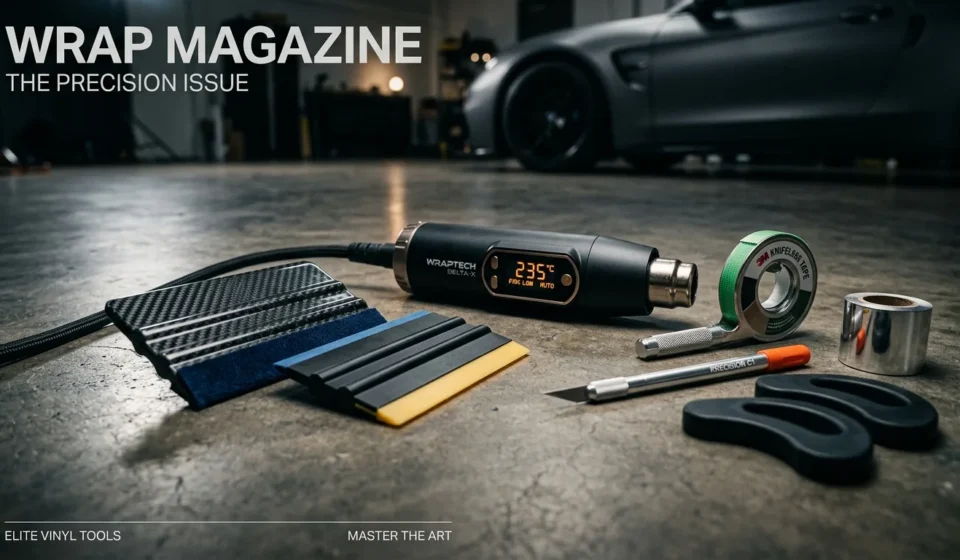
If you’re still relying solely on a knife to cut intricate designs or panel gaps, you’re missing out. Knifeless tape is a filament-based tape that allows you to create precise, clean cuts without ever touching the vehicle’s paint with a blade. You lay the tape down in your desired cut line, apply the vinyl over it, and then pull the filament through the vinyl, creating a perfect cut. It’s a lifesaver for tricky areas like headlight and taillight cutouts, door seams, or creating custom graphics right on the car.
There are different types, but 3M Design Line and Finish Line are industry standards. Design Line is flexible and great for curves, while Finish Line is excellent for straight lines and longer runs. Using Knifeless tape isn’t just about safety; it’s about speed and a level of precision that’s hard to achieve freehand, especially with premium films like 3M 2080 series or Avery Supreme Wrapping Film, where every detail matters.
Specialty Blades and Trimmers
Even with Knifeless tape, you still need to trim excess vinyl. But not all blades are created equal. Professional installers often opt for breakaway blades from brands like Olfa or NT Cutter. Their stainless steel blades are incredibly sharp and allow you to snap off dull segments, ensuring you always have a fresh, razor-sharp edge. For intricate details, a fixed-blade hobby knife (like an X-Acto equivalent) with a #11 blade is invaluable for fine-tuning edges and corners after the main application.
Another often-overlooked tool is a pair of good quality vinyl snips or shears, specifically designed for cutting vinyl without snagging or leaving frayed edges. These are perfect for quickly trimming large sheets or making relief cuts on the fly.
Heat Management Mastery: The Key to Conformation and Longevity
Heat is your best friend and worst enemy in vinyl wrapping. Too little, and the film won’t conform or activate its adhesive properly. Too much, and you’ll stretch it too thin, burn it, or compromise its integrity. Advanced heat tools give you precise control, which is vital for wrapping complex curves and ensuring the wrap lasts 5-7+ years.
Professional Heat Guns
Forget the cheap paint stripper heat guns. Professional heat guns from brands like Steinle or Leister offer variable temperature settings and precise airflow control. They allow you to dial in specific temperatures, which is crucial for different films. For instance, conforming cast vinyl (the premium, heat-activated film that conforms to complex curves without shrinking back) like Oracal 970RA often requires temperatures in the 180-220°F (82-104°C) range, while post-heating edges might go up to 200-240°F (93-116°C). Having this control prevents overheating fragile areas and ensures proper tension relief.
But what would you do in a situation where you need consistent heat over a larger area, like a roof or hood? A high-power heat gun with a wider nozzle or even an infrared heater can distribute heat more evenly, making large panel applications smoother and reducing the risk of cold spots that can lead to lifting over time. Honestly, a good heat gun is one of the biggest differences between an amateur and a pro setup.
Infrared Thermometers
This is where the “guesswork” leaves the building. An infrared (IR) thermometer allows you to accurately measure the surface temperature of the vinyl. This is critical for two main reasons: conforming and post-heating. When conforming vinyl, you want to reach the optimal activation temperature without overheating. During post-heating – a non-negotiable step to “set” the vinyl and prevent memory-related shrinkage – you need to ensure every stretched area reaches 200-240°F (93-116°C) for at least 30 seconds. An IR thermometer takes the guesswork out, ensuring durability and preventing unsightly edge lifting down the road.
Detailing & Post-Installation: The Finishing Touches That Matter
The wrap isn’t done until the details are perfect. These tools address the tiny imperfections and secure the wrap for the long haul, separating a decent job from an exceptional one.
Rivet Brushes and Specialized Squeegees
Wrapping over rivets or textured surfaces (common on commercial vans or older trucks) requires specific tools. A 3M Rivet Brush, or similar, with its stiff bristles, is designed to push the vinyl down into and around rivets, ensuring proper adhesion and preventing bubbling. It’s a simple tool, but indispensable for fleet vehicles. Similarly, specialized squeegees like those with felt edges (for delicate surfaces) or hard plastic squeegees with micro-edges are perfect for getting into tight crevices or burnishing down edges with precision. I always keep a variety of squeegees on hand, from soft rubber to hard plastic, because each has its ideal application.
Edge Sealers and Adhesion Promoters
For areas prone to lifting, like deep recesses, sharp corners, or cut edges on bumpers, edge sealer tape or a liquid adhesion promoter is your best friend. Adhesion promoter, like 3M Primer 94, is applied to the vehicle surface before the vinyl, creating a stronger bond. It’s especially useful for tricky plastics or areas with high tension. Edge sealer tape, a thin, transparent tape, goes over the very edge of the vinyl, providing an extra mechanical barrier against lifting. Using these on areas like mirror caps or door handle recesses significantly extends the life of your wrap, helping achieve that 5-7+ year longevity we all strive for.
The ‘Invisible’ Tools: Environment and Knowledge
Let me add something here: some of the most crucial “advanced tools” aren’t physical objects you hold. They are the conditions you work in and the knowledge you possess. A clean, dust-free environment with consistent temperature control is paramount. Imagine this situation: you’ve just spent hours perfectly wrapping a complex front bumper on a 2024 Tesla Model Y, which easily costs $600-$900 for that section alone, only to find microscopic dust nibs because you worked in a drafty garage. Frustrating, right?
Proper lighting, both ambient and focused task lighting, is also indispensable for spotting imperfections and ensuring even application. Finally, your understanding of different films – calendered vinyl (the more affordable, stiffer film better suited for flat surfaces) versus cast, air-release channels, adhesive activation – is the ultimate advanced tool. Continuous learning, reading articles on Car Wrap Info, and experimenting with new techniques will always be your greatest asset.
Investing in these advanced tools might seem like a significant upfront cost. A professional Steinle heat gun can run you $200-400, a set of quality Knifeless tape rolls $50-100, and an IR thermometer $30-70. However, the time saved, the reduction in material waste from botched attempts, and the superior quality of the finished product translate directly into higher customer satisfaction and a stronger reputation, whether you’re wrapping your own Ford F-150 crew cab (which takes about 18-22 linear meters of 60-inch film) or charging clients for full color changes. These tools are an investment in your craft, your efficiency, and your bottom line. They are the difference between merely applying vinyl and truly mastering the art of the vehicle wrap.