


The DIY Wrapper’s Reality: Mistakes Happen (and That’s Okay!)
So, you’ve taken the plunge into the exciting world of DIY car wrapping! It’s a fantastic way to transform your vehicle, but let’s be real: it’s not always smooth sailing. Even seasoned pros like myself, with over 15 years in the game, have had our “oops” moments. The good news? Most common car wrap mistakes are fixable with the right knowledge, tools, and a bit of patience. At Car Wrap Info, we’re here to arm you with that knowledge.
Table Of Content
- The DIY Wrapper’s Reality: Mistakes Happen (and That’s Okay!)
- 1. Pesky Bubbles and Air Pockets
- 2. Wrinkles, Creases, and Unwanted Folds
- 3. The Dreaded Lifting Edges
- 4. Annoying Contaminants Under the Film (Dust, Debris)
- 5. Avoiding Knife Marks on Paint (A Critical Prevention!)
- Pro Tips for DIY Wrap Success
This guide will walk you through troubleshooting the most frequent issues DIYers encounter, turning those frustrating moments into learning experiences. Let’s get your wrap looking flawless!
1. Pesky Bubbles and Air Pockets
These are perhaps the most common frustrations. You’re laying down that beautiful film, and suddenly, a bubble appears!
- Cause: Insufficient squeegee pressure during application, applying the film too quickly, or tiny contaminants on the surface trapping air.
- The Fix:
- Small Bubbles: For tiny air bubbles (often called “flea bites”), a simple prick with a very fine needle or an air release pen (like a 3M Air Release Pen) is usually all it takes. Then, use your thumb or a soft squeegee to gently push the air out towards the puncture.
- Larger Bubbles/Lifting: If you have a larger air pocket or a section that hasn’t fully adhered, you’ll need to lift the film. Gently peel back the vinyl until you’re past the bubble. Apply light, even heat with your heat gun (around 150-180°F / 65-82°C for most cast vinyl films like 3M 2080 or Avery Supreme Wrapping Film) to relax the material. Then, re-lay the film, working from the center of the lifted area outward with firm, overlapping squeegee strokes.
- Prevention: Thorough surface prep is paramount – clean, clay bar, and degrease the vehicle completely. Work in a clean, dust-free environment. Use a quality squeegee (e.g., 3M Blue, Avery Pro rigid, or Vvivid soft edge) and apply consistent, firm, overlapping pressure. Don’t rush!
2. Wrinkles, Creases, and Unwanted Folds
Wrinkles can make your wrap look amateurish and are often a sign of improper stretching or heat management.
- Cause: Overstretching the film in flat areas, not enough heat in concave or convex curves, or trying to bridge too large an area at once.
- The Fix:
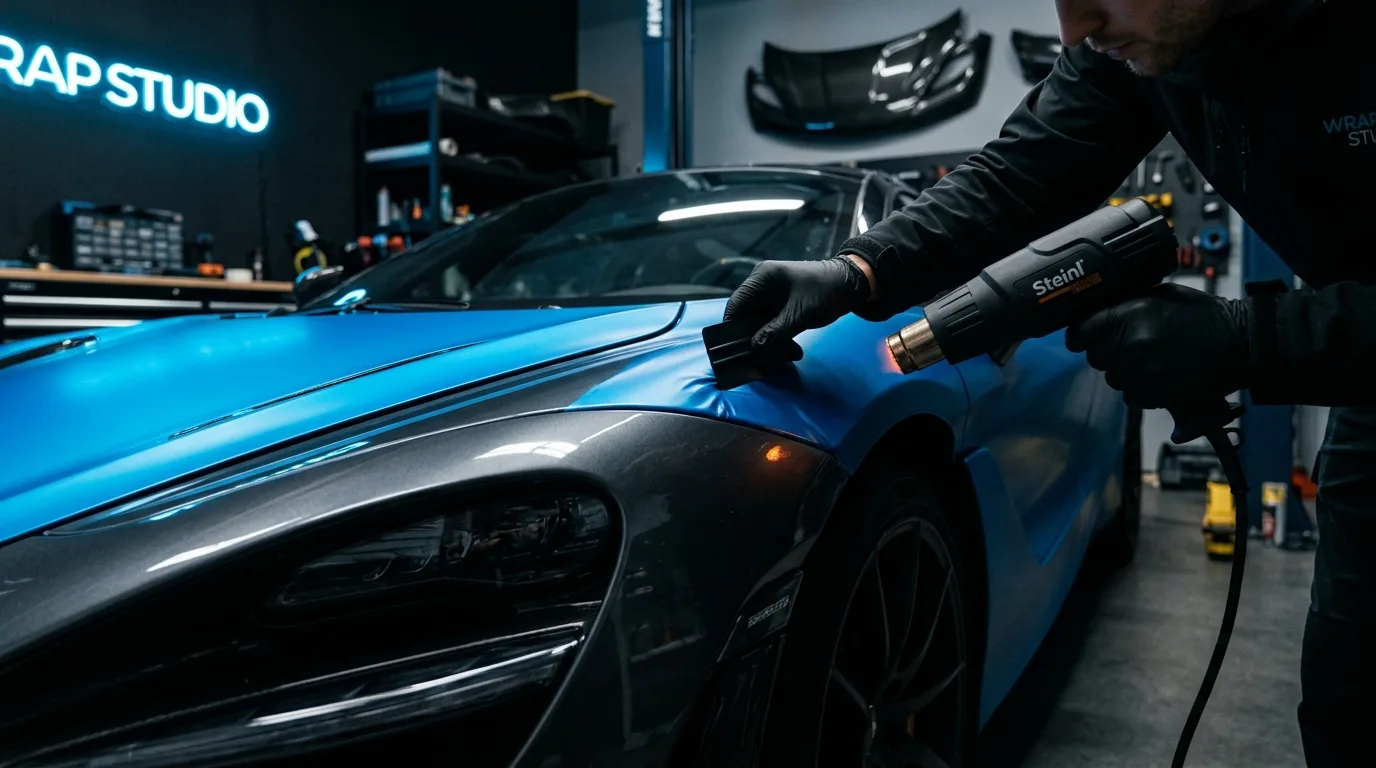
- Minor Wrinkles: Apply controlled heat (150-200°F / 65-93°C) with your heat gun (a Steinel HG2310LCD is excellent for precise control). As the film warms and relaxes, gently stretch and squeegee the wrinkle out. Work slowly and patiently.
- Deep Creases: For more stubborn creases, you’ll likely need to lift the affected section, apply heat to relax the film back to its original state (or as close as possible), and then carefully re-apply. If the film was severely overstretched and stressed, it might be difficult to get it perfectly smooth without creating another tension point. In extreme cases, a small patch might be necessary, though this should be a last resort for visible areas.
- Prevention: Use proper installation techniques. For cast vinyl (the premium, heat-activated film that conforms to complex curves without shrinking back), use heat strategically for stretching only where needed, not to force the film. For larger panels, work in sections and use relief cuts in complex areas to manage tension.
3. The Dreaded Lifting Edges
Nothing screams “DIY job” like a peeling edge. This is crucial for the longevity of your wrap.
- Cause: Insufficient post-heating, not wrapping enough material around edges, dirty edges during application, or improper adhesion pressure.
- The Fix:
- Re-adhere: First, ensure the lifted edge and the vehicle surface are clean. Wipe with isopropyl alcohol (IPA). Gently re-heat the lifted film to its activation temperature (around 200-220°F / 93-104°C for most premium films like Oracal 970RA or Hexis). Press down firmly with a felt-tipped squeegee or your thumb, ensuring maximum contact.
- Post-Heat Again: Once re-adhered, thoroughly post-heat the entire edge. Post-heating is the process of heating the film to a higher temperature (typically 200-220°F / 93-104°C, checking with a non-contact IR thermometer) after installation to “set” the adhesive and relieve any residual tension in the vinyl, preventing it from lifting or shrinking back. Hold the heat gun still for a few seconds on each spot.
- Edge Sealers: For high-stress areas or persistent lifting, consider using an edge sealer. Products like 3M Edge Sealer Tape or liquid edge sealers create an extra barrier against the elements and provide additional adhesion.
- Prevention: Always ensure you have sufficient “overhang” (e.g., 1/2 to 1 inch) of material to tuck around edges, into door jambs, or under trim. Clean edges meticulously before tucking. And most importantly, always, always post-heat all edges and areas where the film was stretched or conformed. This step is non-negotiable for longevity (aiming for 5-7+ years!).
4. Annoying Contaminants Under the Film (Dust, Debris)
The smallest speck can look like a mountain under a wrap.
- Cause: Inadequate surface preparation, working in a dusty environment, or static electricity attracting airborne particles.
- The Fix:
- Careful Removal: For small specs, the only real fix is to carefully lift the film past the contaminant, use tweezers or a blast of compressed air to remove the particle, and then reapply. This is delicate work and can introduce new contaminants if you’re not careful.
- Prevention: This is almost entirely about prevention. Work in the cleanest, most dust-free environment possible. Thoroughly wash, decontaminate with a clay bar, and degrease (IPA wipe) the vehicle. Use lint-free towels. Consider wearing wrap gloves (e.g., Vvivid wrap gloves) to avoid fingerprints.
5. Avoiding Knife Marks on Paint (A Critical Prevention!)
This isn’t a “fixable” mistake, but a preventable disaster.
- Cause: Pressing too hard with your knife blade, using the wrong angle, or using a dull blade that requires more pressure.
- Prevention:
- Use Knifeless Tape: This is your best friend for cutting vinyl on the vehicle without touching the paint. Brands like 3M Knifeless Finish Line Tape or Design Line Tape allow you to create clean, precise cuts safely.
- Practice Makes Perfect: If you absolutely must use a knife, practice on scrap pieces. Use a fresh, sharp blade (change often!). Hold the blade at a very shallow angle (almost flat) and apply minimal pressure – just enough to score the vinyl, not the paint. Never cut directly on painted surfaces unless absolutely necessary, and if so, use extreme caution.
Pro Tips for DIY Wrap Success
Beyond fixing specific mistakes, here are some general pointers from the shop floor:
- Patience is Your Best Tool: Rushing leads to mistakes. Take breaks, step back, and breathe.
- Invest in Quality Tools: A good heat gun (Steinel, Makita), a variety of squeegees (3M Gold, Avery Pro, Vvivid), Knifeless tape, a fine-tip air release pen, and wrap gloves make a huge difference.
- Temperature Matters: Work in a controlled environment, ideally between 65-75°F (18-24°C). This helps the film behave predictably.
- Always Post-Heat: I can’t stress this enough! Every edge, every curve, every stretched area needs to be post-heated to ensure maximum adhesion and longevity.
- Don’t Be Afraid to Lift and Re-lay: Good quality cast vinyl (like 3M 2080 or Arlon Ultimate PremiumPlus) is designed to be lifted and reapplied multiple times during installation. Use this feature!
Wrapping your own vehicle is incredibly rewarding. While mistakes are part of the learning curve, with these troubleshooting tips and a commitment to proper technique, you’ll be well on your way to a professional-looking finish. Keep practicing, and your car will thank you for it!