Quick answer: commercial vehicle wraps maximize brand impact by turning your fleet into 24/7 high-visibility advertising assets that protect paint and lower long-term marketing costs. Using premium 2-mil cast vinyl like 3M 2080 or Avery Dennison SW900 ensures a 5 to 7-year lifespan with clean removal, delivering up to 70,000 daily visual impressions per vehicle for a fraction of traditional billboard fees.
Understanding the ROI and Marketing Value of Fleet Wraps
According to data from the Outdoor Advertising Association of America (OAAA), a single commercial vehicle wrap generates between 30,000 and 70,000 visual impressions per day depending on your market and driving patterns. Unlike digital ads that disappear the moment your monthly budget runs out, a professionally installed vinyl wrap continues advertising your business for 5 to 7 years. When you calculate the cost per thousand impressions (CPM), commercial wraps cost around $0.15 to $0.35, compared to $3.50 for traditional billboards and over $20.00 for targeted digital pay-per-click campaigns.
Beyond pure impression volume, wrapped service vehicles build immediate trust with prospective customers. When a clean, branded van arrives at a residential job site, neighbors take notice and feel confident in the legitimacy of your business. That initial visual impression eliminates local safety concerns and establishes an authoritative community presence. Furthermore, wrapping your fleet acts as a sacrificial shield for your factory paint, protecting the underlying finish against gravel chips, light surface scratches, road salt, and harsh sun fading.
When fleet operators decide to sell or return leased vehicles after four or five years, peeling back the vinyl reveals paint in near-factory condition. This preservation drastically reduces end-of-lease wear-and-tear penalties and boosts resale market value by hundreds or even thousands of dollars per unit. Choosing to invest in commercial fleet graphics effectively pays for itself through paint protection and lead generation combined.
Choosing the Right Wrap Coverage: Full, Partial, or Spot Graphics
Not every business requires a bumper-to-bumper transformation to achieve massive brand recognition. Selecting the right coverage style depends on your available equipment budget, graphic complexity, and vehicle body style. Understanding your options helps optimize your return without overspending on unnecessary vinyl coverage.
Full Vehicle Wraps
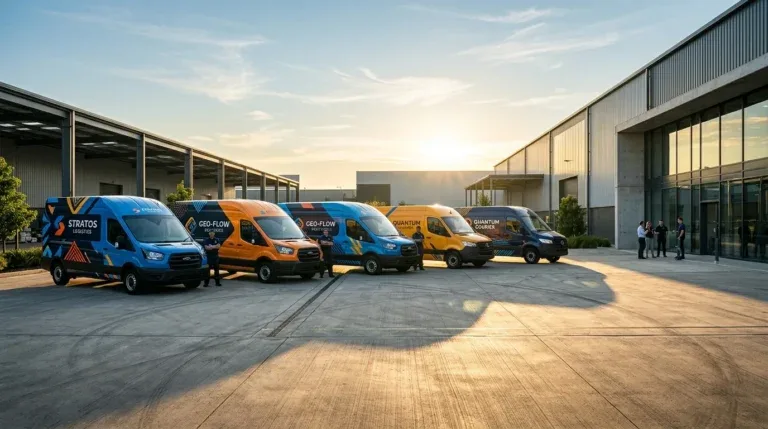
A full wrap covers 100% of the painted surfaces, including the hood, side panels, rear doors, roof, and bumpers. This option provides a completely unified background color, making it perfect for older fleets with mismatched vehicle colors or worn factory paint. A typical full wrap on a standard high-roof cargo van like a Ford Transit or Ram ProMaster requires approximately 25 to 30 linear meters (roughly 450 to 550 square feet) of 60-inch wide cast film. Full wraps offer maximum visual punch and complete paint protection across every panel.
Partial Vehicle Wraps
Partial wraps cover between 25% and 75% of the vehicle’s exterior, strategically integrating the vehicle's factory paint color into the graphic artwork. Common designs feature wrapped rear halves combined with matching hood accents or geometric side stripes. By leaving complex areas like front bumpers, door handles, and intricate side mirrors unwrapped, partial wraps significantly lower installation labor costs. Choosing a partial installation allows you to get 80% of the visual impact of a full wrap while reducing material and labor expenses by up to 40%.
Cut Vinyl Lettering and Window Graphics
For budget-focused fleet managers, cut computer graphics present an economical starting point. High-performance plotter-cut logos and phone numbers apply directly to door panels and tailgates. Combining side door logos with perforated window film on rear glass allows your drivers to maintain rearward vision from inside while displaying high-contrast brand messaging to following traffic outside. Perforated rear window film uses a 50/50 or 60/40 pattern of micro-punctures to maintain interior visibility safely.
Installer tip: Avoid wrapping recessed door handles, deep bumper contours, and complex roof channels with cheap, thick vinyl films. Over my 15 years in the shop, I've seen hundreds of DIY and budget wrap jobs bubble and snap away from deep recess channels within 6 months because the installer over-stretched the material without proper post-heating. Save time and prevent lifting by using Knifeless tape to relief-cut around sharp mechanical recesses instead of forcing vinyl into places it doesn't want to stretch.
Material Comparison: Cast vs. Calendered Vinyl
Selecting the correct film specification determines whether your investment lasts for seven years or fails after seven months. Vinyl films come in two primary manufacturing categories: premium cast films and economy calendered films. Using the wrong material on complex vehicle curves is the single biggest mistake fleet managers make.
Cast vinyl (typically 2.0 to 3.5 mils thick) begins life as a liquid polymer poured onto a moving casting sheet. Because it experiences no mechanical stretching during creation, cast film exhibits zero inherent shape memory. When heated, it conforms seamlessly to deep door channels, body lines, and curved fenders without trying to pull back or shrink. Top-tier cast systems like 3M Print Wrap Film IJ180Cv3, Avery Dennison MPI 1105, or Oracal 3951 RA incorporate air-release channels within the pressure-activated adhesive layer. These micro-grooves allow trapped air to slide out smoothly during squeegee application, eliminating unsightly air bubbles.
calendered vinyl (typically 3.5 to 6.0 mils thick) is manufactured by pulling solid plastic dough through hot rollers. This process leaves residual tension in the film. While calendered vinyl works well for flat box-truck panels or temporary short-term promotions, installing it on curved vehicle doors leads to premature edge curling, cracking, and adhesion failure within 12 to 18 months under sun exposure. For durable commercial application, pair cast printable vinyl with a matching cast glossy or matte laminate (such as 3M 8518 or Avery DOL 1360) to protect ink against harsh UV rays and chemical road grime.
| Property / Specification | Premium Cast Vinyl | Intermediate Calendered Vinyl |
|---|---|---|
| Manufacturing Method | Poured liquid, stress-free sheet | Rolled solid dough, high internal tension |
| Film Thickness (Without Laminate) | 2.0 – 2.5 mil (0.05 – 0.06 mm) | 3.5 – 6.0 mil (0.09 – 0.15 mm) |
| Outdoor Durability Rating | 5 – 7+ Years (UV Protected) | 1 – 3 Years (Flat surfaces only) |
| Conformability | Superior (Deep channels, rivets, curves) | Poor (Flat walls, simple box trailers) |
| Average Installed Fleet Cost (2026) | $3,200 – $5,500 per full vehicle | $1,500 – $2,800 per full vehicle |
Designing Commercial Fleet Graphics for High Visibility
A vehicle wrap design differs fundamentally from print brochures or desktop web pages. Viewers usually encounter your wrapped vehicle while moving at 50 miles per hour, giving them approximately three to four seconds to digest your message. Over-complicating the visual layout with dense paragraphs, realistic photos, or busy patterns destroys the clarity of your core brand message.
Focus your layout on three fundamental elements: your primary business logo, a ultra-short service line (e.g., "Plumbing & Heating"), and a prominent contact method (a bold phone number or short website domain). High-contrast color combinations—such as bright white text over deep navy blue backgrounds or vibrant yellow lettering over matte dark charcoal—yield maximum legibility from a distance. Avoid low-contrast pairings like light red text over medium orange paint.
When working with your graphic designer, demand vectors scaled precisely to 1:10 scale templates matching your exact fleet year, make, model, and door configuration. Placing critical text over door handles, fuel doors, sliding door seams, or window molding spoils your finished look. Make sure to consult our detailed guide on designing graphics for high-impact fleet wraps to avoid common layout errors before sending files to the print shop.
Commercial Fleet Wrap Costs & 2026 Price Breakdown
Budgeting accurately for commercial wraps requires looking at both material volume and installation labor costs. The total investment varies depending on vehicle physical size, surface complexity, film selection, and design complexity. Below is a realistic 2026 price breakdown for professional installation using top-shelf cast vinyl (such as 3M 2080 or Avery Supreme Wrapping Film):
- Cut Vinyl Lettering & Door Logos: $450 – $950 per vehicle (Ideal for service sedans and basic fleet pickup trucks).
- Partial Wrap (30% to 50% Coverage): $1,400 – $2,600 per vehicle (Best balance of cost and visual presence for delivery vans).
- Full Wrap – Compact Cargo Van (e.g., Ford Transit Connect): $2,800 – $3,800 per vehicle.
- Full Wrap – Full-Size Extended Van (e.g., Mercedes Sprinter High-Roof): $4,200 – $5,800 per vehicle.
- Full Fleet Discounts: Most commercial shops offer 10% to 18% tier discounts when wrapping three or more identical fleet units concurrently.
Although initial costs may seem substantial compared to simple magnet decals, remember that professional installation includes critical steps like pre-application paint prep, post-heating recessed seams with a digital heat gun to 180°F–200°F (82°C–93°C) to lock memory, and sealing edges with specialized primer. Choosing cheap installers who skip post-heating guarantees premature film lifting and edge peeling within months. Learn more about maintaining overall vehicle value by reading our article on how vinyl wrap protects original car paint.
Maintenance Practices to Reach a 7-Year Lifespan
Protecting your wrap investment requires proper ongoing maintenance. Commercial fleets face tough daily exposure to diesel exhaust, road tar, tree sap, and harsh weather. Establishing a routine cleaning schedule prevents environmental pollutants from baking into the porous top laminate layer.
Wash wrapped vehicles hand-style or use touchless automated car washes at least twice per month. Avoid automated car washes equipped with rigid mechanical nylon brushes, as these aggressive rotating bristles tear micro-scratches into graphic film laminate and lift material edges. If using a high-pressure washer, maintain a minimum distance of 18 inches from all vinyl edges, keep water pressure below 2,000 PSI, and hold the nozzle completely perpendicular (90-degree angle) to the vehicle body surface to avoid blowing water under film borders.
Never apply standard petroleum-based automotive waxes to vinyl wraps, as heavy solvent compounds dissolve adhesives and yellow white vinyl. Instead, apply a synthetic ceramic detail spray or dedicated wrap sealant every three months. Synthetic coatings fill microscopic pores in the film laminate, creating a hydrophobic protective layer that sheds water and blocks UV radiation. For complete care instructions, refer to our comprehensive guide on cleaning and maintaining vehicle wraps.
When it is time to upgrade your branding or sell off older fleet units after five to seven years, professional removal requires warming the panels with a commercial heat gun or propane torch to approximately 120°F (49°C). Heating softens the adhesive matrix, allowing the vinyl sheet to pull off smoothly at a 45-degree angle without ripping or leaving heavy glue residue behind.
Final Recommendations for Fleet Owners
If you own a small fleet of service vehicles, prioritize long-term durability over short-term savings by specifying premium 2-mil cast vinyl (such as 3M 2080 or Avery SW900) paired with a matching cast UV gloss lamination. Start by commissioning a high-contrast, uncluttered design scaled to your exact vehicle templates, and ensure your installer performs thorough post-heating procedures to seal deep body channels permanently.
Frequently Asked Questions
How long do commercial vehicle wraps last on work trucks?
When crafted from high-grade cast vinyl and properly maintained, commercial wraps last between 5 and 7 years outdoors. Lifespans vary slightly based on sun exposure, local weather conditions, and cleaning routines.
Can you wash a wrapped vehicle in an automatic car wash?
Touchless automatic car washes are completely safe for wrapped vehicles. Avoid car washes that use mechanical rotating brushes, as they scratch film laminate and lift vinyl edges over time.
Will removing a fleet wrap damage the original vehicle paint?
No. As long as your vehicle retains its factory OEM paint finish, removing cast vinyl using proper heat technique will not damage underlying paint. In fact, wraps preserve original paint from sun fading and road scratches.
How much vinyl film is needed to wrap a full-size cargo van?
Wrapping a full-size high-roof cargo van (like a Ford Transit or Ram ProMaster) typically requires between 25 and 30 linear meters (roughly 80 to 100 feet) of 60-inch wide vinyl roll material.